Gray wolf
Sleek white coat. Powerful muscles. Our gray wolf is always curious, often on the move. Come meet her.

Our gray wolf Tala was born April 22, 2013, at the Catoctin Wildlife Preserve and Zoo in Maryland. She came to live here later that year.

America is home to two species of wolf, both of which are endangered. Gray wolves are hunted but are critical to balanced ecosystems. Red Wolves have been brought back from the brink of extinction – but only just. Read the story for more.
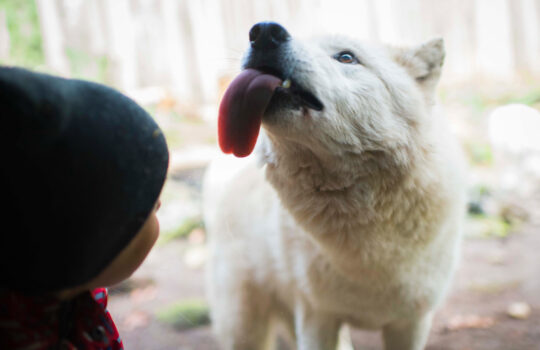
Step inside this cozy forest cabin to get an up-close look at our wolf and learn more about how you can do science every day.
Feel the softness of a real pelt and climb into the tunnel to get nose-to-nose with a gray wolf! (Activities vary.)
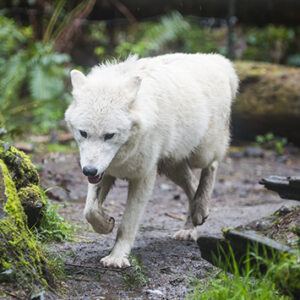 Keepers describe Tala as aware, alert, proactive and sweet – when she wants to be. She’s motivated by food, and her favorite is any whole prey item, like an elk carcass or rabbit.
|
One name
Many colors.
|
Despite the name, the gray wolf’s coat can range from almost pure white to black. |
They range over forest and tundra in Northern U.S. and Alaska, Europe and Asia. |
|
A complex society
And wary of humans.
|
Wolves live and hunt in a pack that is structured socially in class layers, with an alpha male and female at the top. |
Wolves are endangered in the U.S. They’re naturally wary of humans and prefer to flee or avoid them if possible. |
|
So much to say
In so many ways.
|
Wolves communicate visually in sophisticated ways, using body posture, facial expressions and tail positions. |
Audible communication is the howl, which bonds the pack, helps them reassemble and is sometimes just for play. |