Forest & Wetlands
Deep inside the Northwest Trek forest, there’s another forest – a habitat filled with native woodland and wetland animals right next to the trail. Find playful river otters, adorable badgers, splashing beavers, and more.
River otter
Lontra canadensis

WHAT: River otters are members of the weasel family, adapted for water living. They have streamlined bodies, short legs with webbed hind feet and a smaller skull.
WHERE: Fresh and salt water that doesn’t freeze throughout North America.
SIZE: Length 3.5 to 4.5 feet (including tail); height 7 to 9 inches; weight 15 to 20 pounds.
EATS: Fish, small mammals, birds, reptiles, amphibians, invertebrates.
BABIES: Breeding from June to July. After an 8-month pregnancy the female gives birth to 2 to 7 young, weighing less than ½ pound.
STATUS: Secure.
FUN FACTS: Otters are among the most playful of mammals: they chase, slide and play with objects.
Near den entrances, otters often twist tufts of grass together to use as scent stations to mark territory or attract mates.
Unlike other members of the weasel family, otters are sociable, living in family groups and sometimes traveling with another family.
Beaver
Castor canadensis
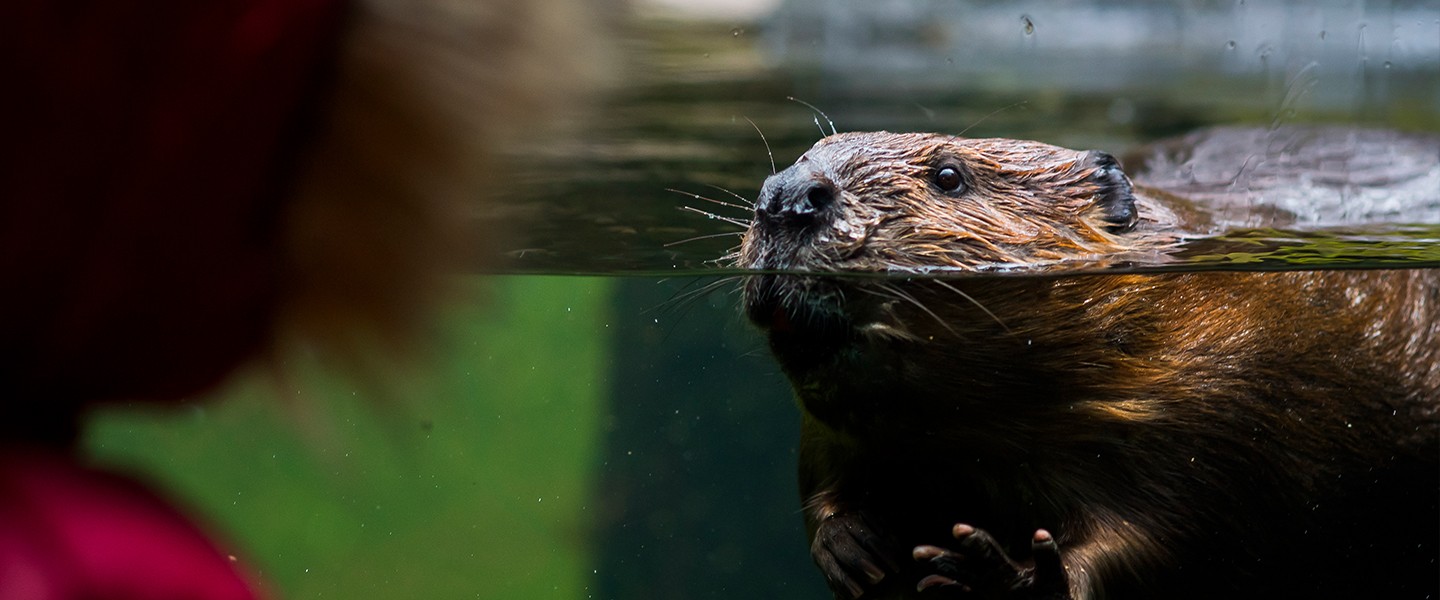
WHAT: Beavers are large rodents, with blonde to black fur. They have small ears and eyes, and a long, horizontally flattened, paddle-shaped and scaly tail.
WHERE: Forested areas with fresh water across North America.
SIZE: Length 4 feet; height up to 12 inches; weight 40 to 60 pounds.
EATS: Leaves, bark, stems and roots.
BABIES: Breeding from January to February. After a 3-month pregnancy, females give birth to 2 to 3 kits that weighs about one pound.
STATUS: Secure.
FUN FACTS: Beavers are communal animals that live in family groups. When kits reach 2 years old they are driven off.
They are active anytime, but usually nocturnal around humans. When alarmed a beaver will slap its tail on the surface of the water, creating a loud warning for others.
Beavers are engineers, second only to humans in their ability to alter their environment. They work together to construct elaborate dams and lodges to create ponds or wetlands.
Badger
Taxidea taxus
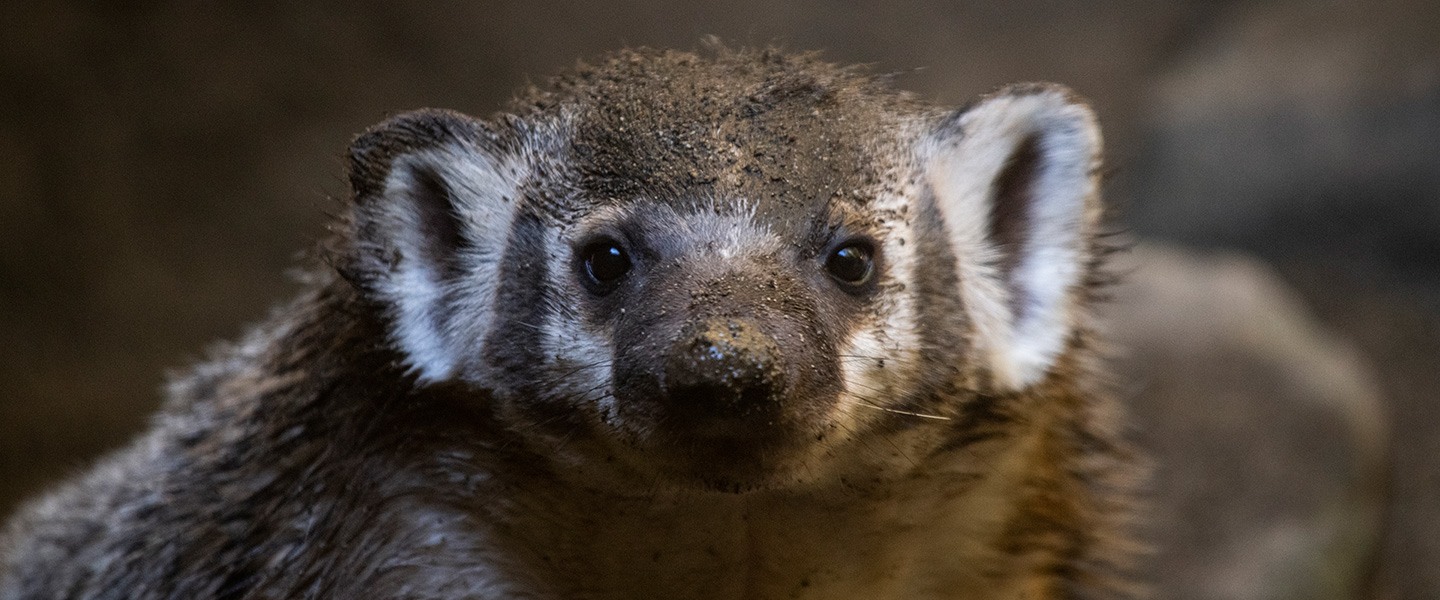
WHAT: A short-legged, heavy-bodied carnivore with a flattened appearance and distinctive white stripe from nose to back.
WHERE: Dry, open country
SIZE: Length 2 to 2.5 feet; weight 15 to 20 pounds.
EATS: Small mammals, reptiles, birds, invertebrates and occasionally plants.
BABIES: Breeding June to July. After a 7-week pregnancy, females give birth to 2 to 7 young, which weigh less than ½ pound.
STATUS: Secure.
FUN FACTS: Badgers excavate. They dig to find prey, to escape danger, and to survive winter temperatures.
They’re known for solitary behavior and aggressiveness. When cornered badgers will snarl, expose their teeth, and sometimes snap their jaws together.
Although not true hibernators, they will den up during cold weather.
Skunk
Mephitidae
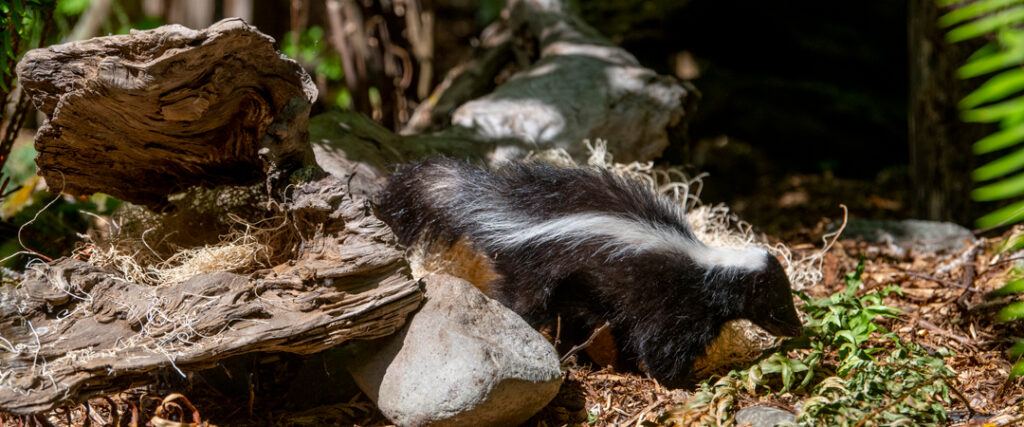
WHAT: Striped skunks are one of many species of skunk. The skunk’s fur is black with a white stripe that begins as a triangular shape on the top of its head and splits into two stripes that travel down the sides of its back, merging again near the base of its tail.
WHERE: Live in various habitats: woods, plains, and desert areas. They prefer open or forest edge habitats. They are abundant in agricultural lands where food and cover are plentiful as well as urban habitats.
SIZE: About 2.6 feet in height and about 14 pounds.
EATS: Skunks are nocturnal, opportunistic and omnivorous predators. They feed extensively on insects like grasshoppers and beetles, but will also eat small mammals, birds, fruit, plants, worms, eggs, larvae, reptiles and even fish. Skunks help control insect populations.
BABIES: Females typically give birth from April to June after a 62 to 68 day gestation. They give birth to 2 to 10 kits per year.
STATUS: IUCN Status Least Concern
FUN FACTS: Skunks have a good sense of hearing, but their vision is poor. Skunks are often reluctant to spray as they only carry enough of the chemical for 5 to 6 uses. The spray can take up to 10 days to regenerate. Instead, skunks usually display a routine of hisses, foot stamping, and a tail-high threat posture prior to spraying.
Marten
Martes americana

WHAT: American martens are also known as pine martens. Martens have the typical weasel shape and may be seen in a variety of colors ranging from silver-grey to burnt umber.
WHERE: Live in forested habitats ranging from Alaska to the northeastern United States along with most western states.
SIZE: About 20 to 30 inches in length including the tail, about 7.5 inches in height and weighs about 2 to 4 pounds.
EATS: Martens are omnivores, feeding on a wide variety of foods ranging from small mammals and birds to berries, insects, and fungi.
BABIES: Breeding season extends from July through August. After about 9 months, the female gives birth to 2 to 5 young. At birth, a newborn kit weighs only about an ounce.
STATUS: Secure
FUN FACTS: Martens are excellent at climbing trees. Although the marten is a skilled climber, they spend much of their time on the ground, watching for movement from potential prey above them.
Raccoon
Procyon lotor

WHAT: The two most recognizable features of a raccoon are the ringed tail and the black facemask. The grizzled coat varies in color according to the range.
WHERE: Found almost anywhere near water but absent from true desert
SIZE: Length about 3 feet including tail, height 9 to 10 inches at the shoulder; weight 15 to 18 pounds.
EATS: The diet consists of anything they find or capture, especially aquatic animals.
BABIES: The breeding season extends from January through February. The gestation period is about 60 days. Generally, the female gives birth to 2 to 5 young. At birth, the newborn kits weigh 2 to 4 ounces.
STATUS: Common.
FUN FACTS: Raccoons are very curious animals, handling and investigating almost everything they discover. The extremely sensitive forepaws are the primary mode for analyzing the potential food that often comes from the water. This dexterous manipulation gives the appearance of washing food.
Forest Stories
Brrr! You can feel the chill in the air as the temperature drops. You’re likely pulling out your winter coats, if you haven’t already! Many of the animals at the wildlife park also have their winter coats ready and are well-prepared for the colder weather. Wolverine Wolverines are made for the cold- and our wolverine Rainier is no exception. Wolverines are well-adapted for winter living, with extremely dense fur, large snowshoe-like paws that allow them to stay on top of deep snow and crampon-like claws that enable them to climb up and over steep cliffs and snow-covered peaks. Their thick …
Whenever Friday the 13th rolls around, even the least superstitious of us might look askance at a black cat or shiver at an owl hoot. But animal superstitions, although fun, can cause pretty bad luck for the wildlife who cross their paths. After all, we live in a world where 350,000 tourists can visit Scotland in one year just to try and spot the Loch Ness monster. If that same number of people all decided to hunt wolves or support the illegal trade in tiger parts, that would have a devastating effect on some amazing animals who are neither good …
Valentine’s Day is just around the corner and love is in the air at Northwest Trek Wildlife Park! There’s no concrete way to measure an animal’s love but many of the animals at Northwest Trek are coupled up, or longtime companions, and enjoy each other’s company. Of course, Valentine’s Day isn’t just for couples- it’s about celebrating friendship and family, too! Grizzlies Bromance. Bro-entines (like, galentines). Brotherly love. Whatever you want to call it, grizzly bears Hawthorne and Huckleberry have it. While not technically brothers, they both arrived to Northwest Trek as cubs around the same age, orphaned in the …