Most people visit Northwest Trek Wildlife Park to see animals like grizzly bears, gray wolves, bald eagles, moose, and bison. But beyond the animals living at Northwest Trek under human care, guests will notice the “bonus” wildlife throughout the park: wild raccoons, squirrels, snakes, and many birds.
“The forest and habitat surrounding Northwest Trek provide a wonderful home for a diversity of native species,” said the wildlife park’s conservation program coordinator, Rachael Mueller. “It’s one of the reasons Northwest Trek is a key place to band birds.”
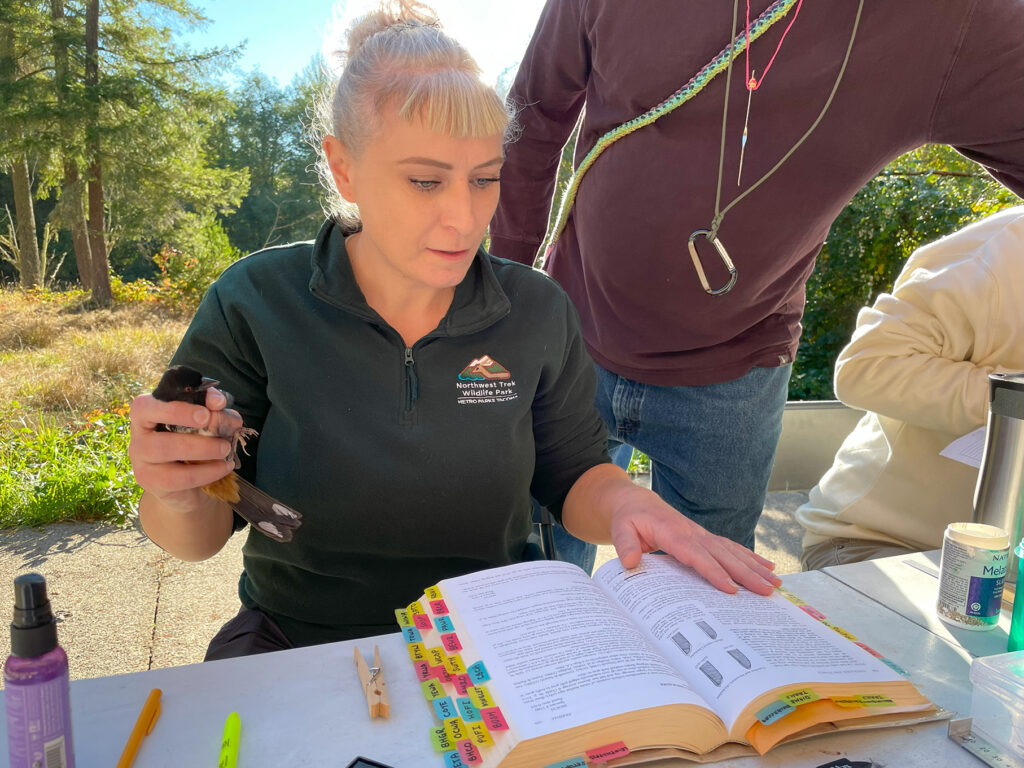
The Puget Sound Bird Observatory and Northwest Trek partnered to present PSBO’s Beginner Bird Banding Course this fall. Over two weekends, 13 students, 11 coaches, one instructor, and several Northwest Trek staff members worked together to learn the fundamentals of bird banding as a research. This is the third year since 2015 that Northwest Trek has partnered with PSBO to present this course.

USGS (United States Geological Survey) aluminum alloy bands engraved with unique numbers are put on birds’ legs to identify and keep track of individual birds. Before a band is secured, researchers use a special tool to measure the bird’s leg to ensure they are selecting the perfect size for the species and individual.

“Bird banding is a great way to connect with and learn about individual birds,” said Mueller. “The valuable information we gather contributes to our understanding and care for wildlife. The data also helps us make informed decisions and support vital conservation efforts.”

According to the United States Geological Survey, the organization that keeps records on all banded birds, bird banding can help:
- Locate nesting and wintering grounds for wild species.
- Learn about territorial and reproductive behavior.
- Determine lifespan, survival rate, reproductive success, and population growth.
During the course, participants banded 156 birds representing 24 species. Some highlight species:
- Three species of woodpecker: Red-breasted Sapsucker, Downy Woodpecker, and Northern Flicker;
- Five sparrow species: Song Sparrow, Fox Sparrow, White-crowned Sparrow, Golden-crowned Sparrow, Spotted Towhee, and Oregon Junco;
- Three warbler species: Townsend’s Warbler, Audubon’s Warbler, Orange-crowned Warbler;
- Hutton’s Vireo, Brown Creeper, and a late migrating Swainson’s Thrush.
“The most remarkable species caught was a Northern Pygmy Owl in its pre-adult plumage, indicating that it is less than one year old,” said Scott Markowitz, Director of Research at PSBO.

“Getting to observe birds up close and know that you are contributing to their conservation is truly special” said Zach Hawn, Conservation Coordinator at Point Defiance Zoo & Aquarium. “Participating as a student, I was able to learn how complex the process is and the care that is taken when handling birds for research.”

“We’re excited to continue our partnership with the Puget Sound Bird Observatory,” said Mueller. “We profoundly appreciate the valuable data and exceptional science our collaboration has produced.”
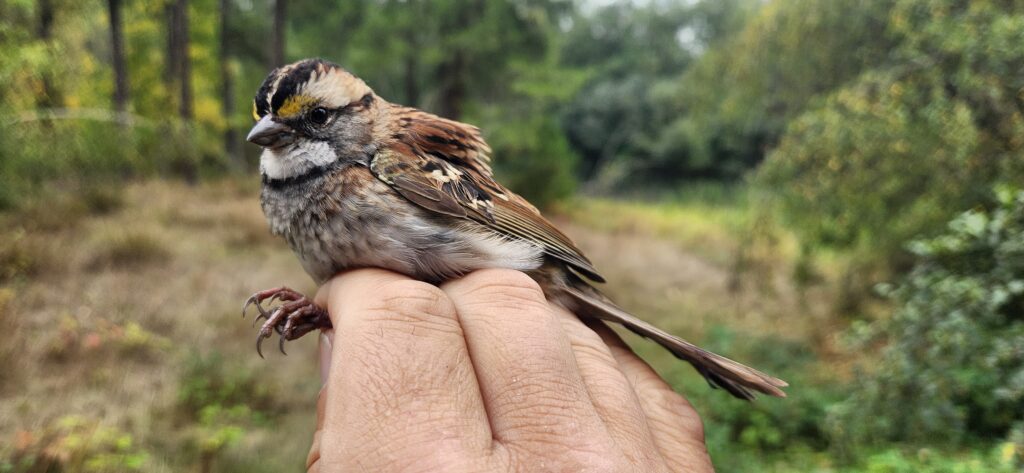
Handling and banding birds requires special training and permits, but the public can help by reporting birds with federal bands or color markers on the USGS website here.